

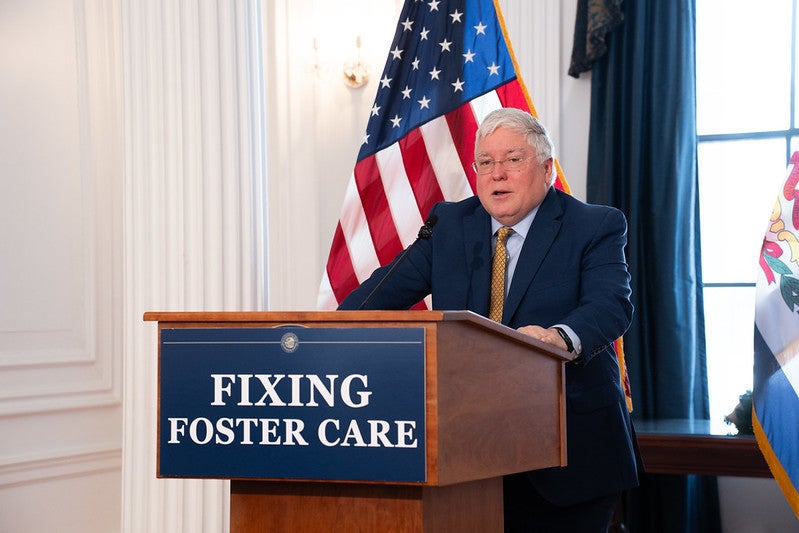
CHARLESTON, W.Va. – Governor Patrick Morrisey today highlighted measurable progress in West Virginia’s child welfare system, pointing to improved outcomes for children, families, and providers while continuing to address long-standing structural challenges within Child Protective Services.
“One of my top priorities is bringing West Virginia children home and keeping them close to their families and communities whenever it is safe to do so,” said Governor Patrick Morrisey. “For too long, kids were sent out of state because our system lacked capacity and coordination. We are changing that by expanding in-state options, supporting providers, and making sure placements are driven by children’s needs, not system gaps.”
Governor Morrisey introduced a legislative proposal to establish a home base initiative fund for renovations and repairs to existing state properties, expanding the capacity to treat children in West Virginia instead of sending them out of state. He reiterated a key focus of his administration is bringing West Virginia children home and reducing reliance on out-of-state placements.
Since taking office, the Morrisey administration has overseen significant systemwide improvements. Statewide CPS backlogs have been reduced by more than 50 percent, the largest improvement in five years. The number of children in state custody has steadily declined, with a reduction of 298 children over the past federal fiscal year.
“Our responsibility is to protect the children, support the families, and make sure the system works for the people of West Virginia,” said Governor Patrick Morrisey. “We are focused on fixing problems, strengthening accountability, and delivering real results that people can see and measure.”
The administration has also prioritized permanency and family-based care with more than 1,100 adoptions completed. Kinship care has been expanded through new pilots and partnerships with Concord University and Marshall University to provide specialized training and trauma-informed support for caregivers, particularly for children with higher needs.
At the same time, the administration has worked to stabilize operations that previously created strain for providers and staff. Workforce stability has improved, with vacancy rates dropping to 8.5 percent and turnover declining from 27.7 percent to 15 percent, the lowest combined rate in five years.
“Children do better when they can stay connected to family and community whenever it is safe to do so,” said Department of Human Services Secretary Alex Mayer. “That is why we are investing in kinship care, adoption, and in-state capacity instead of relying on stopgap solutions.”
Financial accountability and system reliability have also been a focus. Improved billing verification processes have prevented improper payments and initiated recovery of more than $4.5 million owed to the agency. Modernization efforts are underway to stabilize systems, improve payment accuracy, and provide frontline workers and providers with more reliable tools to manage cases and services.
“These are not quick fixes, and they are not cosmetic changes,” Governor Morrisey said. “They are deliberate steps to build a child welfare system that is stable, accountable, and worthy of the children and families it serves.”