

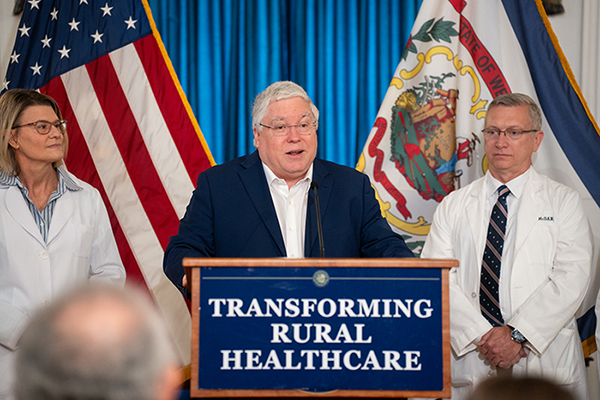
CHARLESTON, W.Va. – Governor Patrick Morrisey today announced that West Virginia has secured more than $202 million in second-year funding through President Donald Trump's Rural Health Transformation Program (RHTP), bringing the state's two-year total to more than $401 million as it moves forward with investments to improve rural healthcare across all 55 counties.
"This additional $202 million will help us expand access to care, strengthen rural hospitals, and address the chronic health challenges facing West Virginia," said Governor Morrisey. "We're building a healthcare system that improves health outcomes, brings quality care closer to home, and helps more West Virginians get healthy and return to the workforce."
The $202,081,355 award, announced Monday by the U.S. Department of Health and Human Services (HHS), represents an increase of approximately $2.6 million over West Virginia's first-year allocation of $199.5 million. The funding is part of the Trump Administration's $50 billion, five-year initiative to modernize rural healthcare across all 50 states.
West Virginia enters the second year having obligated 100 percent of its initial award through 145 signed awards and agreements, all finalized ahead of the October 30 federal deadline. Those projects reach all 55 counties. Recipients have also committed an additional $21.9 million in matching resources, including cash and in-kind contributions, extending the reach of the federal investment.
"We set out to put every dollar of our first-year award to work, and we got it done ahead of schedule," Governor Morrisey said. "Now we're building on that momentum with another $202 million. I want to thank President Trump, Secretary Kennedy, and Dr. Oz for recognizing the challenges facing rural communities and supporting the state-driven solutions that will help us build a healthier, more prosperous West Virginia."
These investments are strengthening rural hospitals, expanding access to primary and specialty care, and addressing critical shortages in the healthcare workforce. Projects already underway include efforts to restore maternal healthcare services, expand mobile clinics and telehealth, bring advanced diagnostic and monitoring technology into rural communities, and improve prevention and treatment of chronic diseases such as diabetes. Together, these initiatives are designed to improve healthcare outcomes while helping more West Virginians get healthy and return to work.
West Virginia fully obligated its first-year agreements directly with the hospitals, clinics, universities, agencies, community organizations, and businesses carrying out the work. Each award is subject to budget reviews, performance requirements, and federal cost rules to ensure taxpayer dollars are used effectively.
The Department of Health is now focused on implementation, tracking project milestones, monitoring expenditures, and measuring improvements in healthcare outcomes. First-year funds must be spent by September 30, 2027, and projects must demonstrate how they will remain sustainable beyond the five-year federal funding period.
“The Trump Administration’s $50 billion Rural Health Transformation Program gives states the resources and flexibility to bring care closer to home and build stronger, more sustainable health care systems for their rural communities,” said CMS Administrator Dr. Mehmet Oz. “As the program enters its second year, this next round of funding will help West Virginia build on the progress made in year one and continue working toward lasting improvements in access, quality, and health outcomes for rural communities.”
The Rural Health Transformation Program was established through the Working Families Tax Cuts Act signed by President Trump. The program provides $10 billion annually over five years, with state awards determined in part by progress implementing approved rural healthcare transformation plans.
This press release is supported by the Centers for Medicare & Medicaid Services (CMS) of the U.S. Department of Health and Human Services (HHS) as part of a financial assistance award totaling $401,557,453.35 in combined Year 1 and Year 2 funding, with 100 percent funded by CMS/HHS. The contents are those of the author(s) and do not necessarily represent the official views of, nor an endorsement by, CMS/HHS or the U.S. Government.